
Roofing Distribution Space Along the I-80 Corridor
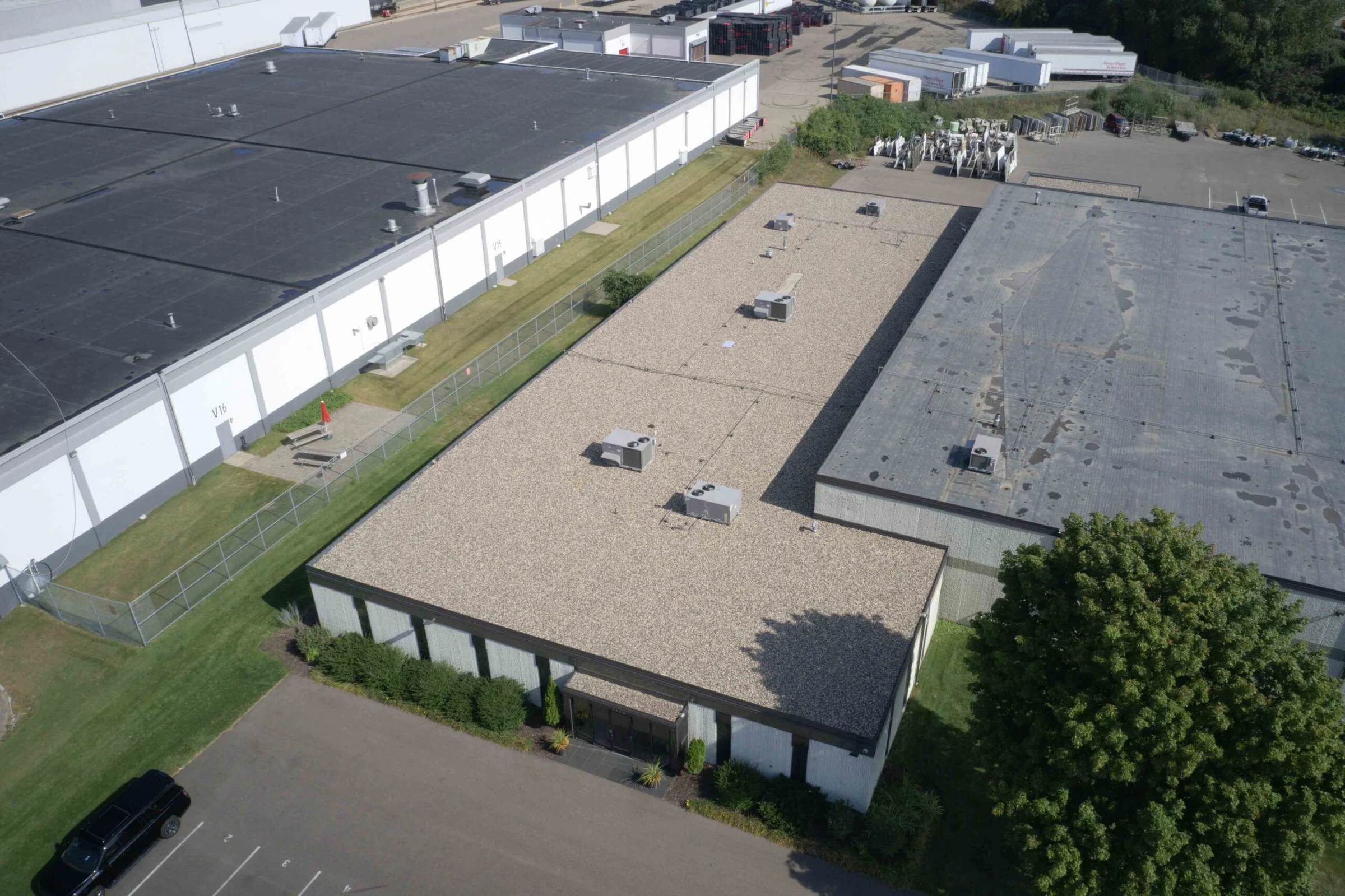
Warehouse and distribution buildings have expanded steadily around Lincoln's I-80 interchanges and through the Air Park industrial area on the old Lincoln Air Force Base grounds, and most of them run large, flat, single-story roof fields built for efficiency rather than architecture. That scale is exactly what makes drainage, insulation, and reflectivity decisions matter more per square foot than on almost any other building type in this market.
Large Flat Fields Put Drainage First
A warehouse roof spans a wide, unbroken field with drains spaced across the interior rather than concentrated at the perimeter like a smaller building. Interior drains that get partially blocked or roof fields with inadequate slope create ponding areas that can sit for days after a rain event, and standing water is one of the fastest ways to age a membrane before it's earned its full service life. We trace every interior drain and check tapered insulation on any warehouse roof before recommending a coating or recover.
Interior drain access matters as much as drain condition on a warehouse roof, since racking, mezzanines, or tenant storage below can make it hard to reach a drain line for cleaning or repair without coordinating with the tenant's operations team first. We map drain access alongside drain condition during inspection so any needed repair can be scheduled around the tenant's storage layout rather than discovered as a surprise mid-repair.
Reflectivity Matters More at Scale
A reflective membrane on a hundred-thousand-square-foot warehouse roof does more work than the same membrane on a small retail building, simply because there's more roof surface converting sunlight into heat that the building's HVAC or ventilation system has to manage. Distribution buildings with climate-controlled zones for inventory see a direct reduction in cooling load from switching a dark, aged membrane to a white TPO or PVC system, and even buildings without full climate control benefit from lower radiant heat reaching the warehouse floor.
Insulation Value on Buildings With Minimal Original Spec
A lot of older distribution buildings in this market were built to a minimal insulation standard because the space wasn't originally intended for climate-sensitive inventory. As tenant use shifts toward products that need temperature control, the roof's R-value becomes a real constraint. We evaluate whether a recover with added polyiso insulation makes sense given the building's current tenant needs before defaulting to a like-for-like replacement.
Tenant lease terms sometimes specify a minimum insulation standard for climate-controlled space, and a roof recover is often the most cost-effective point to meet that standard since the insulation layer is already being addressed. We coordinate with property management on lease requirements before finalizing an insulation spec, so the completed roof satisfies both the building's energy performance and whatever standard the tenant's lease requires.
- Interior drain tracing across large flat roof fields
- Reflective membrane options sized for large-scale surface area
- Insulation upgrades for buildings shifting to temperature-sensitive tenants
- Fastening pattern and wind uplift review for exposed I-80 corridor sites
- Post-hailstorm inspection across large roof fields
- Skylight and smoke vent curb inspection on older warehouse buildings
Wind Exposure Along the Interstate Corridor
Warehouse sites near the I-80 interchanges tend to sit in open, exposed locations without much wind break, which is part of what makes them attractive for truck access but also puts more stress on roof edges and fastening than a warehouse tucked into a denser industrial park. We check wind uplift rating and perimeter securement specifically for the exposure each site actually has, rather than applying a blanket assumption across the whole portfolio.
Hail Damage Is Harder to Spot on a Large Field
Spring hail across southeast Nebraska hits warehouse roofs the same as everything else, but the scale of these roofs makes visual inspection more involved than a walk across a small retail building. Impact damage can be concentrated in one section of a large field depending on how the storm tracked, and we walk the full roof systematically after a significant hail event rather than sampling a corner and assuming uniform condition.
Air Park Buildings Carry a Different Roof History Than Newer I-80 Sites
Warehouse buildings in the Air Park industrial area, built on the former Lincoln Air Force Base grounds, often carry older roof systems than the newer distribution buildings going up near the I-80 interchanges further out. We evaluate Air Park roofs with that history in mind, checking for outdated fastening patterns and insulation standards that wouldn't meet a newer building's baseline spec.
Questions Distribution and Logistics Facilities Ask Us
How long does inspecting a large warehouse roof take?
It depends on the roof's size and drain count, but we walk the full field systematically rather than sampling sections, since damage and ponding patterns vary across a large roof.
Can you work while the warehouse stays fully operational?
Yes. We coordinate material staging and crew access with dock and yard operations so loading and receiving continue through the project.
Does reflectivity actually matter for a warehouse without climate control?
It still reduces radiant heat reaching the warehouse floor and lowers roof surface temperature, which extends membrane life even on buildings without a cooling system tied to that heat load.
What causes ponding on a large flat warehouse roof?
Usually a combination of insufficient slope, a partially blocked interior drain, or settled insulation creating a low spot. We trace the drainage pattern to find the actual cause before recommending a fix.
How do you inspect for hail damage across a roof this large?
We walk the full field in a systematic pattern rather than spot-checking, since hail tracks can concentrate damage unevenly across a large roof surface.